
Nvidia takes stakes in five British deep-tech start-ups as Huang tours Europe
Nvidia will take minority stakes in five British start-ups working on drug discovery, neurodegenerative disease, algorithm design, infrastructure forecasting and quantum computing. Jensen Huang, the chipmaker’s chief executive,…

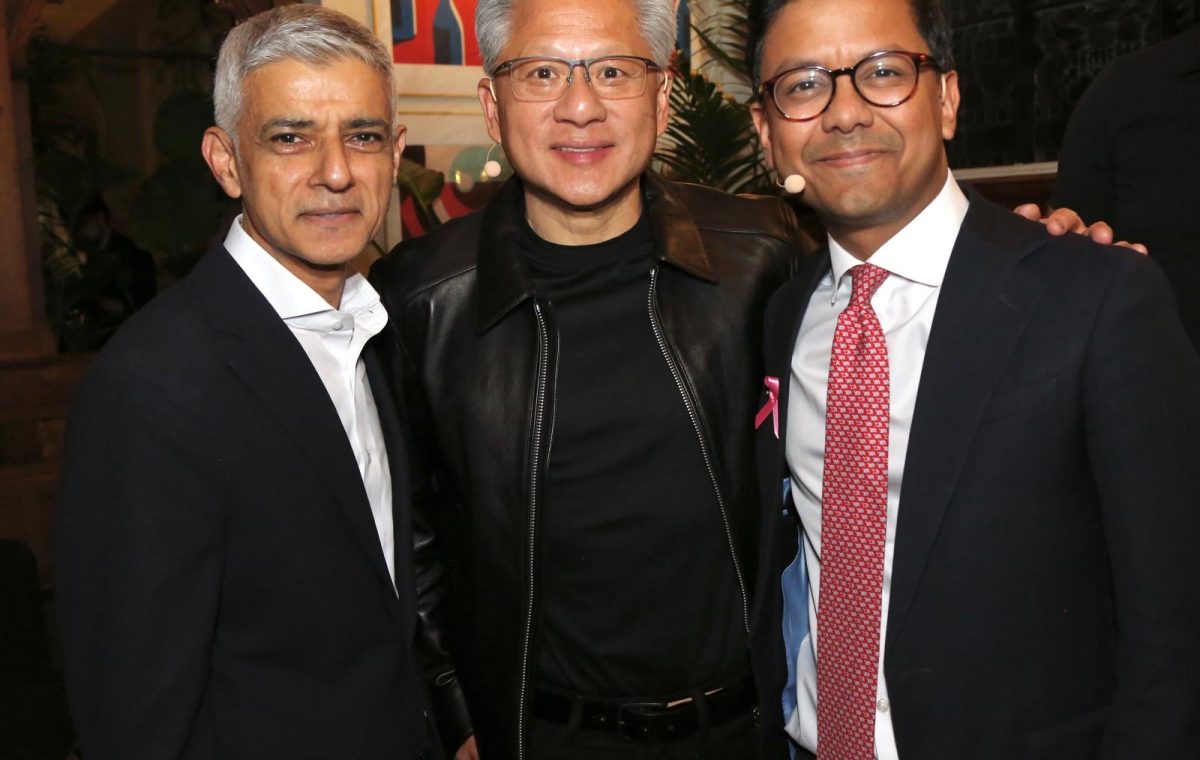
Nvidia will take minority stakes in five British start-ups working on drug discovery, neurodegenerative disease, algorithm design, infrastructure forecasting and quantum computing. Jensen Huang, the chipmaker’s chief executive, announced the investments at an event in London on Wednesday evening, the second stop on a European tour.
The companies are Boltz, Foresight, Hiverge, Prima Mente and Riverlane. Nvidia has not disclosed how much it is investing in any of them, or in total. The company is understood to be taking minority positions. Some reports circulating online have put the total above $1bn. That figure does not appear in Nvidia’s announcement, and the company has not confirmed it.
The selection leans heavily towards science. Boltz is a London company founded by MIT researchers. It builds biomolecular models and AI agents that help scientists predict how molecules are structured and interact, and design possible new medicines. Prima Mente, also in London, is building biological foundation models to understand complex diseases and find new therapeutic targets. It is starting with Alzheimer’s, Parkinson’s and ALS. Hiverge was founded in Cambridge by researchers from Google DeepMind and the university. It develops an AI system that writes and improves algorithms for jobs such as speeding up AI training and planning complex logistics.
The other two are closer to Nvidia’s core business. Foresight, based in London, helps owners of large infrastructure projects, hyperscale data centres among them, forecast completion dates, reduce risk and start earning revenue sooner. Riverlane, a Cambridge quantum company, makes real-time error-correction hardware and software that works across all the main qubit types. Riverlane already has a working relationship with Nvidia. It has shown that GPUs can speed up the recalibration of decoders used in quantum error correction.
The stakes add to an existing UK portfolio. Nvidia already backs British companies including Basecamp Research, Ineffable Intelligence, Synthesia and Wayve. In September 2025, during Donald Trump’s state visit, Nvidia pledged £2bn to the British AI industry, through direct funding for start-ups and partnerships with venture capital firms.
The London announcement was part of a wider push across the continent. Speaking in Paris on Tuesday, Huang said Nvidia expected to announce $2bn of European AI deals within a week, on top of $8bn it has deployed in the region over the past year. He also announced new funding for four French start-ups: Doctolib, Genesis AI, Pigment and Entalpic. That evening, he met Emmanuel Macron at the Élysée Palace.
In London, the start-up stakes came with a separate pledge on AI safety. Nvidia will provide computing resources worth $250m over five years to UK research on AI safety. The research involves Oxford’s BOLD lab, UCL’s SOFAIR lab and Imperial College, and covers the safety of AI agents, the security of open models and defences against real-world threats. British cloud companies will supply the computing capacity, but the providers and commercial terms have not yet been settled. Huang said “AI capabilities and safety must advance in tandem”.
At a reception in a converted church in Mayfair, Kanishka Narayan, the UK’s AI minister, joined Huang and the founders on stage. Huang told the audience that Britain had to “participate in every single layer of the AI economy”. He also urged British entrepreneurs to be more ambitious about growth, arguing that the country had the talent but dwelt too much on failure.
Some analysts were cautious. Indranil Bandyopadhyay, principal analyst at Forrester, said the deals would raise the start-ups’ profile and help them raise more money, but that “minority strategic stakes still leave these firms depending on foreign capital to scale”. He described that dependence as a long-standing weakness of British tech. He also warned that researchers who work mostly on one vendor’s tools could end up producing safety benchmarks shaped by that vendor’s technology. Russ Shaw, founder of Tech London Advocates, was more positive. He said the commitment showed confidence in Britain’s £1.2tn tech sector and would help turn research into commercial products.
The tour now moves to Germany. GTC Berlin runs from 20 to 22 October, and Huang gives his keynote on 21 October. If the $2bn figure he gave in Paris holds, the deals announced so far in France and Britain are not the whole of it
Written by the newsroom, not a summariser. Free, and you can leave whenever.





0 comments
Anyone can read the thread · subscribers can post