
OpenAI publishes 722 AI-generated maths papers, drawing a sharp rebuke from mathematicians
OpenAI has published 722 mathematical manuscripts produced by an unreleased internal model, a catalogue that includes claimed advances on two of the most famous problems in mathematics and…

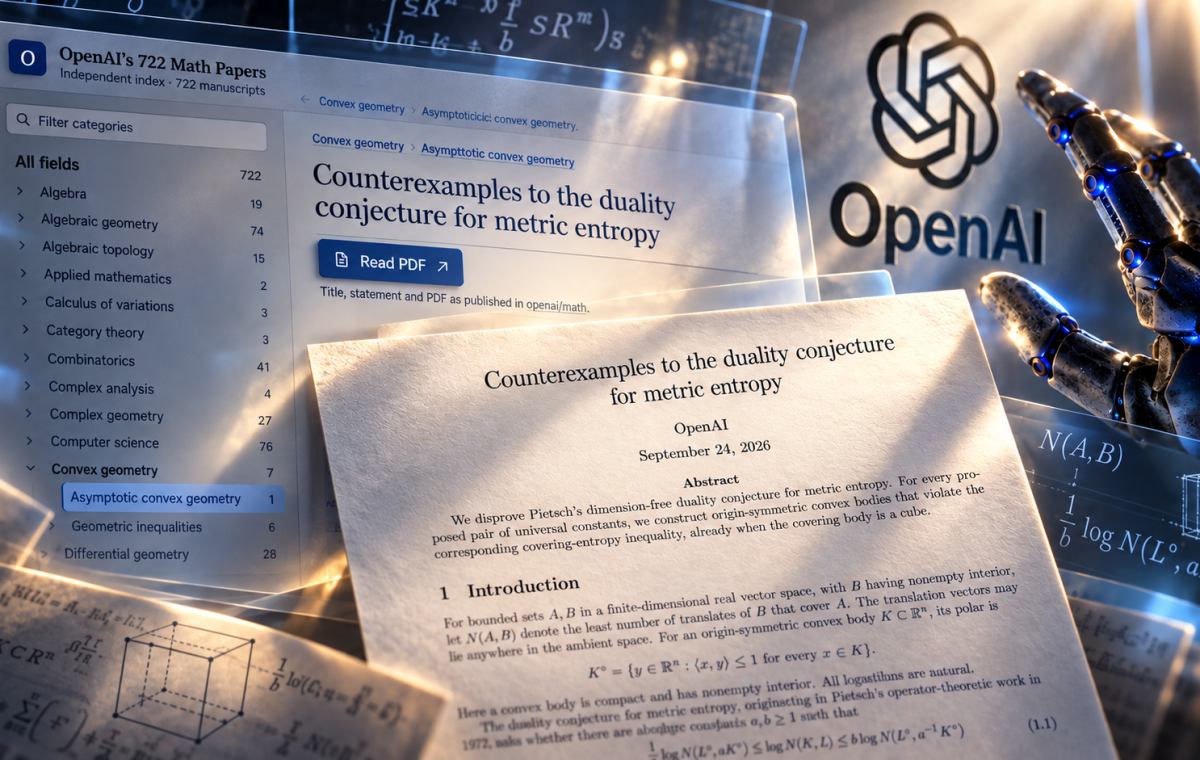
OpenAI has published 722 mathematical manuscripts produced by an unreleased internal model, a catalogue that includes claimed advances on two of the most famous problems in mathematics and that the company acknowledges has not been fully verified.
The papers, released on 6 October, are organised into 372 families, each grouping a principal result with companion arguments, consequences or alternative proofs. According to the repository, the model was posed approximately 4,000 problems, and each result used, on average, three hours of ChatGPT Pro thinking compute. Many manuscripts come with formal proofs in Lean, software that checks each logical step mechanically, but not all do. OpenAI states that some unformalised results “could have issues” and says corrections will be recorded as new versions.
Within a day, the Association for Human Mathematics, an advocacy group of mathematicians, rejected OpenAI’s assertion that the release advances the subject. Its communications working group called the mass publication “a demonstration of power” and urged mathematicians to stop working with the company.
The scale is new. On 1 August, OpenAI disclosed that an internal version of Astra, which it described as its next major model, had produced ten results in mathematics and theoretical computer science. This release is roughly seventy times larger.
Two entries will draw the most scrutiny. OpenAI says that work on a zero-free region for the Riemann zeta function and a proof of the Hodge conjecture for CM abelian varieties were produced outside its standard procedure, and that the write-up for the zero-free region where Re(s) exceeds 11/12 was edited by humans for readability. The Hodge result concerns a restricted class of geometric objects and does not settle the Millennium Prize problem of the same name. The Riemann claim, if it holds, would go well beyond any zero-free region previously proved.
The model has a short and contested record. OpenAI began training it on 28 August and said in September that it had resolved more than 100 long-standing open problems across most areas of mathematics, in addition to its Navier-Stokes result. That claim has not been recognised by the Clay Mathematics Institute and prompted a dispute over credit; OpenAI has denied accessing unpublished research in developing its solution.
The friction shaped how this release was prepared. An advisory group hosted by the Institute for Advanced Study in Princeton, whose nine members include Timothy Gowers, Martin Hairer, Edward Witten and Melanie Matchett Wood, was formed to advise OpenAI on releasing its results. Its members are unpaid, and it says it holds no decision-making power at any AI company. OpenAI’s announcement says it drew on the group’s advice and public recommendations.
Those recommendations, published on 29 September after more than 600 replies from the mathematical community, open with an objection: the group states that it does not endorse testing advanced problems on proprietary models and asks labs to stop. The Association for Human Mathematics seized on that point, arguing that OpenAI had ignored the advisory group’s central premise while presenting the release as shaped by it.
The group’s practical proposals include depositing results in scholarly repositories not controlled by any AI lab, disclosing prompts, a summarised chain of thought, time and computing cost for each result, and explaining how many comparable problems the models failed to solve.
OpenAI’s release meets some of those standards and departs from others. It discloses an average compute figure and the total number of problems attempted, and provides reasoning summaries for ten results, including Kaplansky’s direct-finiteness conjecture in characteristic two and the isomorphism of free group factors. The papers sit on OpenAI’s own GitHub account, though the company says it is exploring community-hosted alternatives. OpenAI also says it will fund workshops, conferences and special programmes on AI-produced results; the advisory group had recommended that such funding decisions rest with existing nonprofit institutions rather than with AI labs.
The model itself remains unavailable. OpenAI says it is working to release it responsibly but has given no date, and has promised further Lean formalisations as it obtains them. Until those arrive, much of the catalogue, including the Riemann and Hodge papers, depends on human reviewers willing to work through it, at a moment when some of them are being urged to walk away.
Written by the newsroom, not a summariser. Free, and you can leave whenever.



0 comments
Anyone can read the thread · subscribers can post