
Police to trial long-range reading of drone “number plates” in London
A government-funded pilot worth £1.7 million will test whether officers can pick up the identification signals drones must now broadcast from further away, after unauthorised flights disrupted football,…

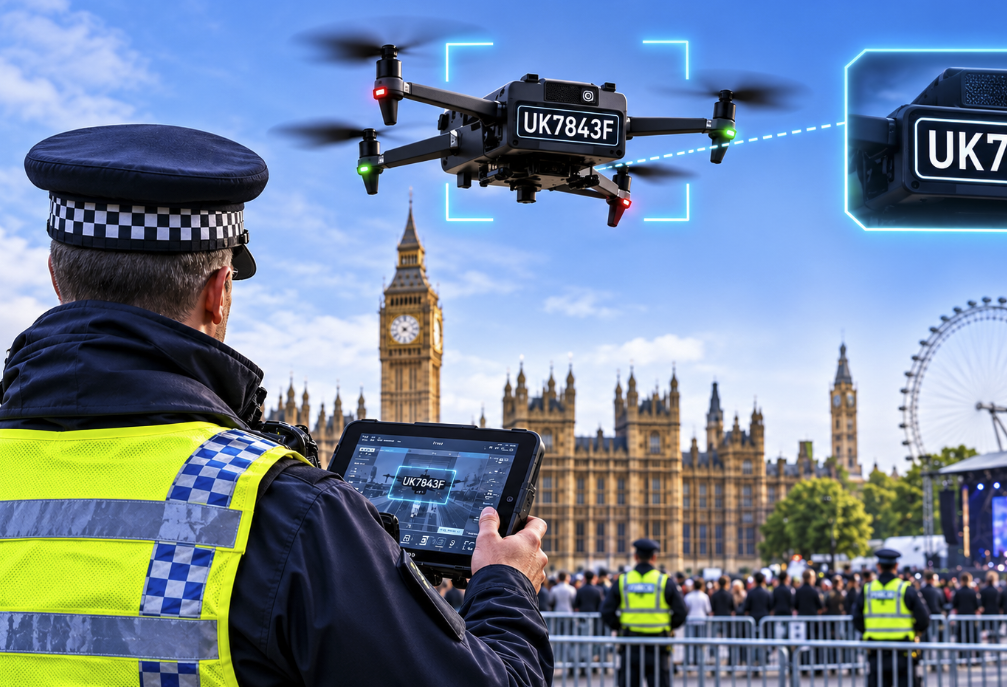
A government-funded pilot worth £1.7 million will test whether officers can pick up the identification signals drones must now broadcast from further away, after unauthorised flights disrupted football, concerts and airport approaches.
Police in London will be given equipment that can read drones’ electronic identification signals from a greater distance, under a trial announced by the Department for Transport on 24 November.
The trial is built around Remote ID, a broadcast that identifies a drone and reports its position. Ministers have taken to calling it a digital number plate. The department says these signals can generally be detected only close to the aircraft. The new equipment is meant to extend both their range and their accuracy, so that officers can map drone activity across the capital and tell authorised flights apart from illegal ones before an incident develops.
The National Police Chiefs’ Council will decide where the equipment goes. The government has not said how many units it will buy, what detection range it expects, or how long the trial will last.
The money comes from two sources. The DfT is putting in £1.2 million and the Regulatory Innovation Office a further £500,000 for police equipment and infrastructure. The department calls this a “nearly £2 million” trial, and the Transport Secretary, Heidi Alexander, referred to a “£2 million investment”. The two amounts named in the announcement add up to £1.7 million.
The trial follows a change in the law at the start of the year. From 1 January 2026, operators have been legally required to fly some drones with Direct Remote ID enabled, depending on their class mark. Legacy or unmarked drones that weigh 100g or more and carry cameras have until 1 January 2028. A signal that can only be read near the aircraft does little for an officer trying to find the pilot, which is why range is the main thing the trial is testing.
The government linked the announcement to a run of incidents. The “Arsenal fixture last month” it mentioned was the Carabao Cup tie away at Fleetwood Town on 27 October. Play was halted barely a minute after kick-off as a drone hovered over the stadium, causing a delay of around eight minutes. According to the BBC, the drone crashed in a nearby residential area. Fleetwood is in Lancashire, so the match was well outside the area this trial covers. The drone seizures at Oasis concerts were also outside London: over the band’s five concerts at Heaton Park in Manchester in July 2025, a total of 10 unauthorised drones were seized.
Airports remain the most serious worry. The DfT said an aircraft met an illegal drone near Heathrow in October, though it gave no further details. Reports from the UK Airprox Board show repeated encounters on approaches to the airport. In one case involving an A320-family jet over central London, investigators said the incident appeared to be a “very near miss” and that the operator could not be traced.
Alexander presented the trial as a security measure. “We’re putting new technology in police hands to track the ‘number plates of the sky’ and crack down on illegal use,” she said.
The department’s other argument is commercial. It estimates that the drone sector could add up to £103 billion to the economy over 25 years, and says the trial will also help drones fly safely alongside other aircraft. That matters to operators such as Apian, a healthcare logistics company founded by NHS doctors that runs drone deliveries for hospitals in the capital. Moving samples between Guy’s Hospital and the St Thomas’ Hospital laboratory can take more than 30 minutes by road but less than two minutes by drone.
Louisa Smith, Apian’s chief operating officer, said that giving police better tools to separate authorised flights from potentially illegal ones “will help build confidence in the safe and responsible use of drones”. She said the company wants to link hospitals and laboratories across London to carry pathology samples, medicines, blood and transplant organs.
The police are drone operators themselves. The Metropolitan Police now operates three drone sites across London, with nine drones deploying to around 200 incidents every week. As police, hospital and commercial flights over the city increase, officers face more traffic to sort through.
The London scheme is one of several. In Birmingham, sensors installed alongside rail infrastructure already give British Transport Police and Network Rail a view of the airspace around key sites. The government is also developing cloud-based drone tracking software aimed at airports and railways, and the trial builds on nearly £50 million for drone and flying taxi technology announced in May. Officials say the London trial is meant to give police greater visibility of drone activity across the country over the longer term.
The trial has a built-in limit. Remote ID detectors can only read drones that broadcast a signal, and many older models will not have to do so until January 2028. Neither will someone who deliberately flies with the signal switched off, and the announcement does not say how the equipment would deal with that case.
Written by the newsroom, not a summariser. Free, and you can leave whenever.


0 comments
Anyone can read the thread · subscribers can post